
What is an ANC?
An ANC (Advisory Neighborhood Commission) is a nonpartisan, neighborhood body each made up of locally elected representatives called Advisory Neighborhood Commissioners. They are a unique feature of the District’s Home Rule Charter.
The Commissioners, who serve two-year terms without pay, are elected in November in even-numbered years (e.g. 2024). The ANCs were established to bring government closer to the people, and to bring the people closer to government.
In addition to providing people with a greater say in the matters that affect their neighborhoods, ANCs were intended to end the duplication of effort caused by the proliferation of special advisory groups.
How are ANCs divided up?
There are now 46 ANCs, up from 40 prior to the 2022 redistricting. Each ANC area is subdivided into a number of smaller areas. Since only one Commissioner is elected per area or district, each is called a Single Member District (SMD). Each SMD consists of about 2,000 people. Although the SMDs should have equal populations, ANCs may vary widely in size. The largest ANCs have 10 SMDs. The smallest has just 2. As a result of the population growth shown in the 2020 census, the number of SMDs has increased from 296 to 345.
What does a Commissioner do?
The ANCs’ main job is to be their neighborhood’s official voice in advising the District government (and Federal agencies) on matters that affect their neighborhoods. Although they are not required to follow the ANCs’ advice, many District agencies are required to give the ANCs’ recommendations “great weight.” Moreover, District law says that agencies cannot take any action that will significantly affect a neighborhood unless they give the affected ANCs 30 days advance notice. This includes zoning, streets, recreation, education, social services, sanitation, planning, safety, budget, and health services.
The ANCs may also initiate recommendations for improving city services, conduct neighborhood improvement programs, and monitor resident complaints. The ANCs began operating in 1976.
Where is ANC 1E?
Advisory Neighborhood Commission 1E represents a vibrant, historic, and rapidly evolving section of Ward 1—including most of Park View, Pleasant Plains, and Howard University.
This part of the city reflects Washington’s richness and complexity: a community shaped by Black homeownership and civic activism, strengthened by academic institutions and local churches, and energized by a new generation of renters, families, and students.
ANC 1E is home to a growing population with strong neighborhood pride and deep civic roots. Residents come from many backgrounds and speak multiple languages, and our blocks include longtime homeowners, new arrivals, tenant organizers, small business owners, and public servants.
We celebrate our walkability, transit access, historic housing, and active community leaders. At the same time, we face serious challenges—from rising housing costs and development pressures to traffic safety, infrastructure needs, and youth support.
Our work as a commission is grounded in listening to residents, fighting for resources, and holding D.C. agencies accountable for inclusive, transparent, and equitable decision-making.
Demographics & Community Snapshot
Estimated Population (Park View Census Tract 32, 2020): ~5,100 residents
Racial and Ethnic Makeup (2020 U.S. Census):
- 36% Black or African American (non-Hispanic)
- 31% White (non-Hispanic)
- 24% Hispanic or Latino
- 4% Asian
- 4% Multiracial or Other
Housing & Income (ACS 2005–2009 for Tract 32):
- Median Family Income: ~$70,200
- Predominantly renter-occupied housing
- Historic unemployment rate: ~9.6%
Neighborhood Characteristics:
- High rate of public transit use and walkability
- Anchored by Howard University and multiple places of worship
- Large student population and growing share of professionals
- Common home languages include English, Spanish, and Chinese
- Rising rents and home values contributing to affordability concerns
Data Note: This demographic snapshot reflects U.S. Census Bureau data from the 2020 Census and American Community Survey (ACS) 5‑year estimates for Census Tract 32, which includes Park View. ANC 1E spans multiple tracts, including parts of Pleasant Plains and the Howard University area. Additional data will be integrated as newer tract-level sources become available.
ANC Maps
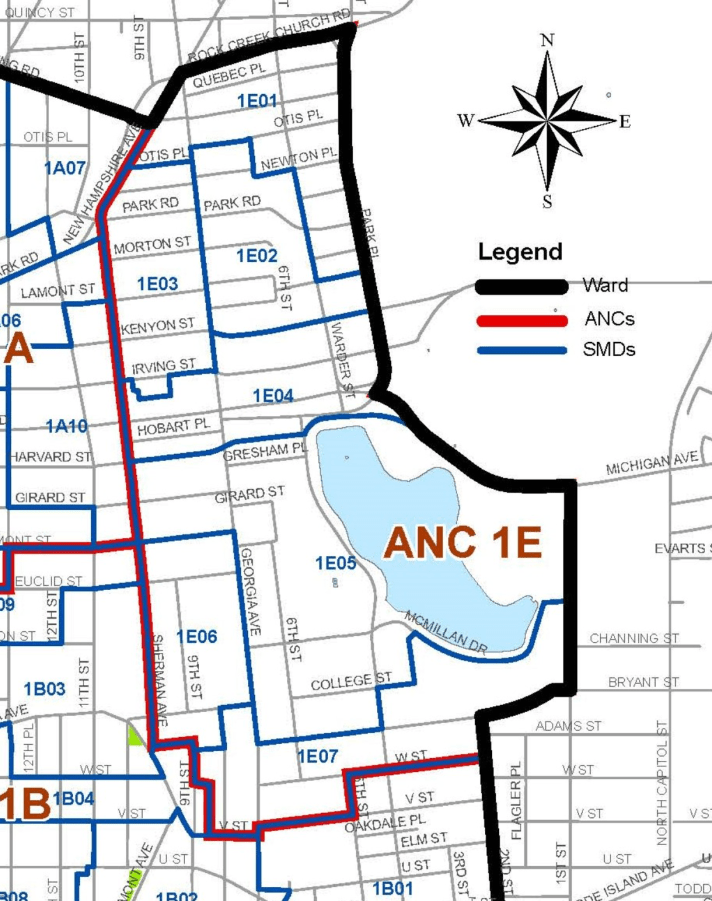
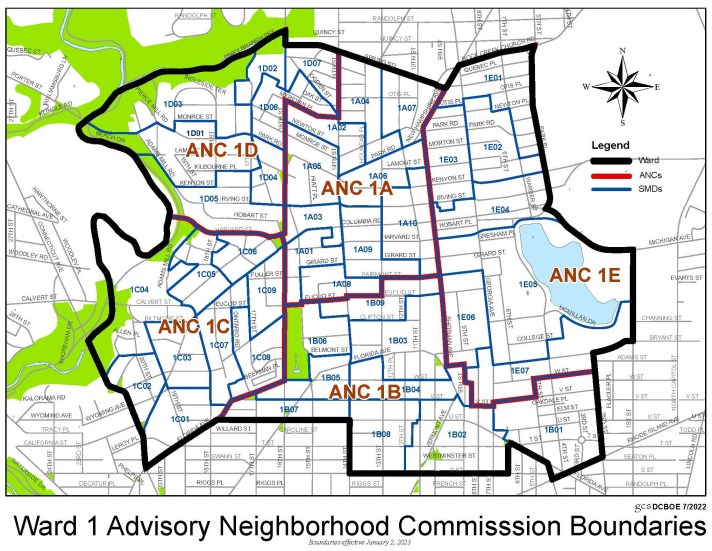
 ANC 1E